A short visit
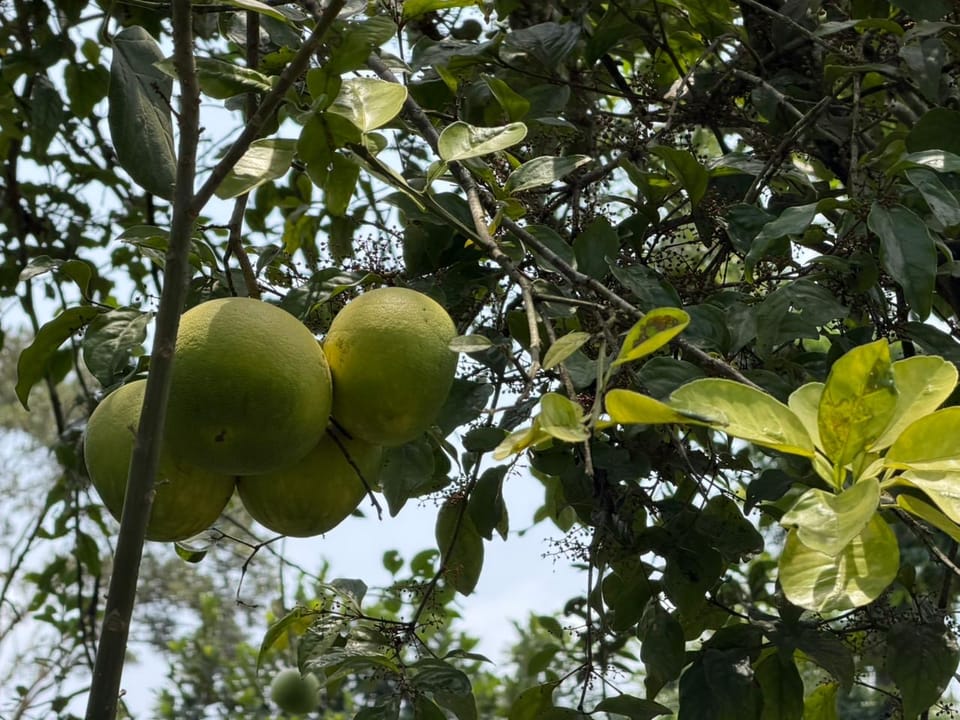
I have neighbors who are as confused as me when it comes to the border, because none of us, except one very kind soul, got a government survey done before buying. When I bought the property I did invite a private surveyor to come check the border, and he walked me through the edges for a small fee. The caretaker I appointed, a local who was the seller's sales agent and knows the ins and outs of the village, later got it surveyed again and found the spots. He has been asking me to come back any weekend to check the edges the surveyor pointed out to him.
I finally found the time, between working on AllyMatter, to go there and check it out for myself. It has to be a Sunday, because Rajesh speaks Kannada and I do not, so we ask his college-going kid to translate for us. My wife laughs at every part of my language skills.
I keep promising myself I will at least learn the basics of Kannada, but it eludes me, what with launching V2 of the software while trying to experiment with outbound messaging and building the infrastructure. I will have to task Claude to teach me Kannada. I do know how to address people respectfully, at least. My caretaker Rajesh is therefore Rajesh Avare, "Avare" being the respectful term, like "Garu" in Telugu or "Ji" in Hindi.
Another reason for the visit was to check the condition of the plantation after the scrub, grass and other small plants were cut and cleared. I was given the option of using Roundup or getting people in with brush cutters, and I chose the latter, since I am not in the mood to put Roundup, or any herbicide, on my plantation at all.
But the most important reason, the one above all, was to plant fruit trees, so that when the house I will eventually build is ready, I have fruit to look forward to. I have never been a big fruit eater, but I want to start, and to see all that can grow there.
The "Highway Nursery" where we bought the plants
My wife requested Guava and nothing else. She is not a big fruit eater either. My niece asked for watermelon and pomegranate. It is too early in the year for watermelon, and pomegranate does not grow in that area (per the kind nursery staff).
I also wanted to make the farm a paradise for fruit lovers, because if not for having fun, ignoring growing food for now, what else is it for me? No farmer with that small an acreage makes a profit unless they work it themselves, which I cannot.
The 54 plants purchased
When I eventually build the home I will add a whole lot of flowering shrubs, creepers and trees, but that is for the next season, or the season when I start to live there. I might plant the slow ones even before I build, the trees that take time to grow, like the Saraca asoca, or True Ashoka, which I think is a beautiful tree. I will also plant the Pride of Burma soon, another beautiful tree.
So this Sunday I drove down, and on the way, with Rajesh Avare and his two daughters, I stopped at a nursery and bought a whole lot of plants for a steep bill.
Here is the list, with a short description of each and how the fruit looks and tastes. (AI generated descriptions)
The safe bets (these should do well)
- Guava, Allahabad Safeda + Thai White + Thai Pink (3). Round green fruit. The Allahabad turns soft, white and fragrant when ripe; the Thai types stay crisp with white or rosy-pink flesh and eat like a sweet apple. This is my wife's one request, so I got three.
- Mosambi / Sweet Lime (2). Pale green-gold citrus with juicy, low-acid segments. The classic sweet morning juice.
- Star Fruit / Carambola (1). A waxy golden fruit that cuts into a five-point star. Crisp and juicy, sweet with a tart edge.
- Wood Apple (1). A hard grey shell about the size of a cricket ball, with brown aromatic pulp inside. Tangy-sweet and intensely fragrant, best as a chutney or a cooling sharbat.
- Nagpur Orange (5). India's famous loose-skinned mandarin. Bright orange, easy to peel, sweet and tangy.
- Sapota / Chikoo, Kalipatti + Cricket Ball (4). Rough brown-skinned fruit with soft, grainy flesh. Malty and sugar-sweet, somewhere between a pear and brown sugar.
- Rose Apple, Panneer (4). Small, pale and bell-shaped, hollow inside. Crisp and watery, lightly sweet, scented like rose water.
- Mango, Mallika + Totapuri + Dasheri (4). Mallika is fiberless and honey-rich, Dasheri is sweet and aromatic, Totapuri is the tangy, reliable one with a parrot-beak tip. These go on the boundary only, they are too dense to grow over the coffee.
- Balaji Lemon (2). A heavy-bearing lemon with big, bright yellow, thin-skinned, very juicy fruit.
- Kazi (Kagzi) Lemon (2). The everyday Indian acid lime. Small, thin-skinned, sharp and very juicy.
- Jamun / Nerale (1). An oblong monsoon fruit that ripens deep purple-black. Sweet, tart and a little astringent, and it stains your tongue purple. I will keep it well off the paving.
- Amla, 2 grafted + 1 Nelli seedling (3). Pale translucent green and ribbed. Bracingly sour and astringent, a vitamin-C bomb for pickles, juice and candy.
- Country / Star Gooseberry, Nelli (1). Little pale-green ribbed berries in clusters. Crisp and very sour, made for pickles and preserves.
- Jackfruit, Shankara (1). The giant of the orchard. A spiky green fruit the size of a bag, full of golden bulbs that are sweet, chewy and heavily perfumed.
- Thai Sweet Cherry (1). A fast little tree with tiny red berries. Soft and very sweet, almost like candy floss. The birds will find it before I do.
The spices (for the shade, under the canopy)
- Allspice (1). Grown for its small brown berries and aromatic leaf. One spice that somehow tastes of clove, cinnamon and nutmeg all together.
- Cinnamon (1). True Ceylon cinnamon, grown for its warm-sweet bark and fragrant leaf rather than fruit.
The gambles (might work at this altitude, might not, worth a shot)
- Mangosteen (2). The "queen of fruits." A thick purple rind hiding snow-white segments that are sweet, tangy and delicate.
- Rambutan (2). Red and soft-spined on the outside, translucent and grape-sweet on the inside.
- Litchi (2). Pink-red bumpy skin over juicy white flesh. Floral and fragrant.
- Longan, Diamond River (1). The "dragon eye." Small tan shells over translucent flesh, sweet and musky, like a gentler lychee.
- Abiu (1). Bright yellow and smooth, with clear, jelly-like flesh that tastes of caramel and vanilla.
- Breadfruit (1). Big, green and knobbly. Starchy rather than sweet, and roasted it tastes like fresh bread.
- Miracle Fruit (1). A small red berry that is bland by itself but rewires your tongue so that sour things taste sweet for a while afterwards. Pure novelty.
- Jaboticaba, Red Hybrid (1). The strange, wonderful one. Grape-like fruit that grows straight out of the trunk, sweet and jelly-soft inside.
The coconuts (for the perimeter)
- Gangabondam (2). A tender-nut coconut with sweet water and a soft kernel.
- Malaysian Green (2). An early-bearing dwarf, also for sweet tender-nut water.
And a start on the flowering avenue (not fruit, but I could not resist)
- Tabebuia Pink (1) and Tabebuia Yellow (1). Two trumpet-flowered trees that bloom pink and gold on bare branches in spring. Just the beginning of the avenue I want to line the road with.
I could not drive into the farm because the road leading to it is all mud, and my car is front-wheel drive, so we had to walk the last hundred or so meters. I will have to build this road soon.
Until next time, see ya.